

Every nervous system is born with a single biological expectation — that a father will be there. Not metaphorically. Physically. A chest to be held against, a gravitational center to orient around, a presence that sends the unspoken message the body cannot generate on its own: you are safe. When that presence is absent, the nervous system doesn’t simply grieve it. It goes looking for a replacement.
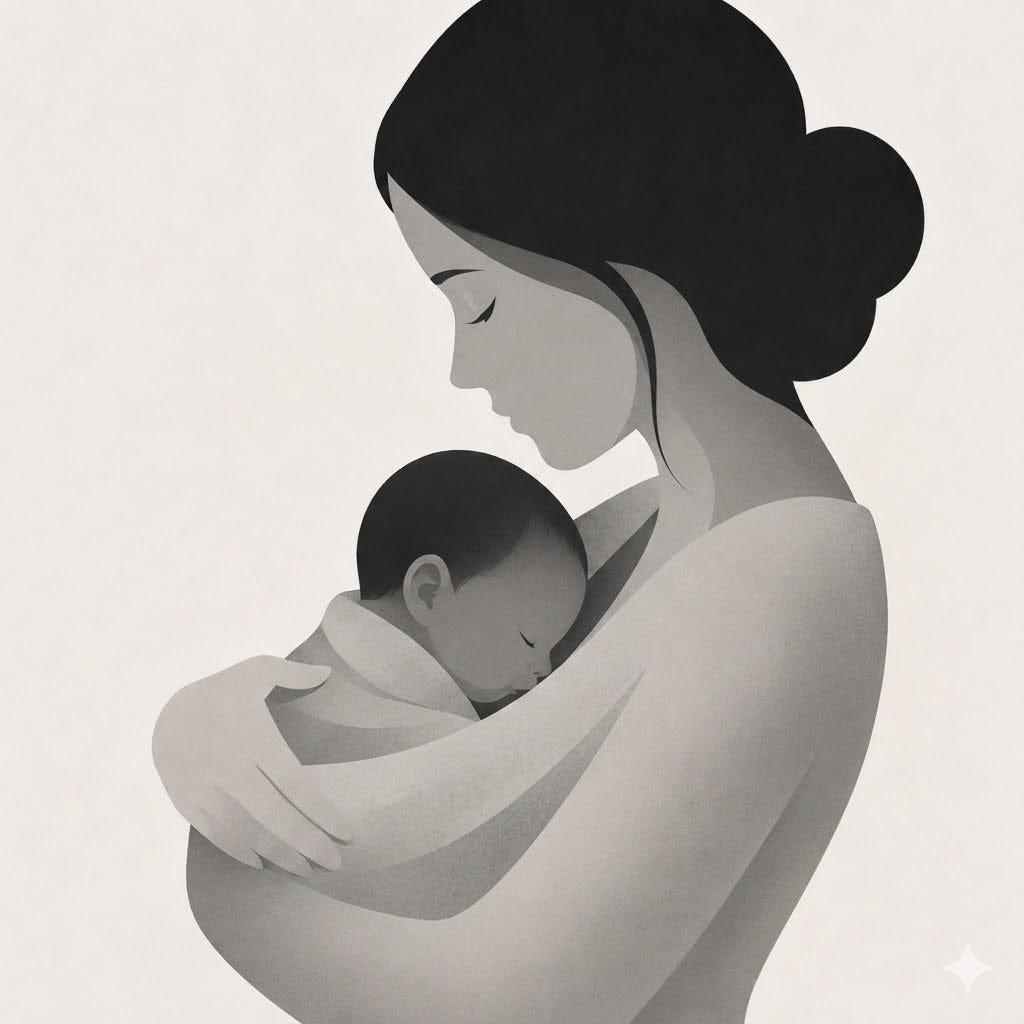
In neonatal medicine, that replacement is called Kangaroo Care — the practice of placing a premature infant skin-to-skin against a parent’s chest when the biological mother cannot provide that contact. Medical science discovered that a newborn’s central nervous system cannot self-regulate on its own. Without that physical touch, cortisol levels spike to toxic thresholds, heart rate destabilizes, and the infant can literally waste away and die. The skin-to-skin contact sends an unspoken biological signal to the body that no amount of willpower can manufacture on its own.
I remember when I first learned this last year, I began weeping. It was such a profound truth that I understood it at my core. I couldn’t help but weep for the reality of it, and for the depth of sadness I felt for the children who historically died as a result of “Failure to Thrive” (marasmus), which is, at its root, a total lack of central nervous system regulation that is biologically necessary for survival.
My body had been trying to tell me this truth for thirty-seven years. I was just finally listening.
I grew up in an environment that scored a perfect ten on the Adverse Childhood Experiences scale. Ten out of ten categories of abuse, neglect, and household dysfunction. My father was a meth addict whose comedowns produced terrifying rage. My mother, carrying her own profound wounds, did not possess the ability to protect herself or her children. By the time I was nine years old, my central nervous system had calibrated itself to a state of constant, hyper-vigilant anticipation just to stay safe.
When the adults in a house are the primary source of unpredictable danger, the nervous system adapts. It stops resting. It learns to read micro-expressions, track tone of voice, and anticipate escalation. It encodes everything at high resolution because survival depends on not being caught off guard. The child does not develop a healthy ego for exploring the world. Instead, they develop a rigid survival suit designed to prevent psychological and physical death.
That suit was what I was wearing at fifteen when I ended up at church camp.
I had not gone looking for God. I went because a friend invited me and I had nowhere else to be. My mother had moved to another city. My father’s house was a psychological war zone. I had been bouncing between friends’ houses for years, self-medicating with alcohol and marijuana to quiet the hyper-vigilance that never stopped running. By the summer I arrived at camp, my nervous system was completely fractured.
On the first night of camp, I heard the evangelical message of Jesus in a way I could actually receive. Forgiveness, connection, and safety. A relationship with a God who would never leave. My brain connected the dots immediately. The sin was my family’s chaos. The salvation was an escape from the terror I had been living in. Christianity was offering everything my nervous system had been screaming for since I was old enough to understand that the adults in my house could not be trusted to keep me safe.
I repeated the prayer. I accepted Jesus as my savior. I felt an immediate peace for the first time in a very long time.
Looking back now, I understand exactly what happened that night. My devastated nervous system had found its Metaphysical Kangaroo Care. Not skin-to-skin contact with a parent’s chest, but something that functioned identically at the biological level. It was a holding environment that sent the same unspoken message the neonatal research describes. You are safe. You are known. You will not be abandoned. The faith did not just give me theology. It gave my nervous system the co-regulation it had never received and could not produce on its own.
What followed was twenty years of building. I built the faith into an impenetrable fortress, surrounding myself with its certainty the way a child surrounds themselves with blankets against the dark. I married well, found community, and built a career. The hyper-vigilant machinery that had been calibrated to threat found a new purpose, managing complexity, building operational frameworks, and optimizing outcomes. The survival suit became a professional asset.
But the nervous system does not forget what it learned before the holding arrived. And the holding that faith provided, however real its effects, was contingent on a set of claims about reality that ultimately shattered against my own baseline of fatherhood. When my firstborn daughter arrived, the fierce, overwhelming love I felt for her completely exposed the insufficiencies of the cosmic framework I was living inside. I sat there holding her and realized that I would do anything within my power to protect her from suffering, a realization that immediately triggered a devastating logic loop. I could no longer reconcile my own desperate instinct to shield my child with the profound lack of protection I had received from a heavenly Father during the absolute terror of my own childhood.
In October 2023, the framework gave way. It was the culmination of a slow erosion, driven by years of therapy that revealed what the theological fortress had been built to protect, the death of my absent father that collapsed my childhood hope of reconciliation, and a single podcast episode that finally cracked the last foundation stone. When that building fell, what collapsed with it was not just belief. It was the primary nervous system regulation structure I had been operating inside for twenty years.
Deconversion, I discovered, does not feel like changing your mind. It feels like the Kangaroo Care being removed. The cortisol spikes. The heart rate destabilizes. The old childhood chaos rushes back in as if it had been waiting just outside the door the entire time.
This is not an argument that faith is merely psychological and therefore false. Nor is it a dismissal of the theological explanations offered for suffering. It is an observation about embodiment: regardless of those explanations, my childhood body was still left to regulate its terror in isolation. The metaphysical truth of religion may be impossible to prove. But the physiological consequences of terror are not.
Regardless of the theological arguments for why the suffering was allowed, I was the one left holding the somatic debt.
The tragedy is not that faith functions as a biological shield. The tragedy occurs when the intellectual honesty the faith itself demands finally turns on its own foundations, ultimately leaving the individual completely exposed. The same rigorous truth-seeking that the evangelical tradition taught me eventually produced questions the tradition could not answer.
What do you do when the thing that saved your life is no longer able to be believed?
I spent year and a half after the deconversion in a void I can only describe as a psychological freefall. Without the holding structure, my nervous system had no external regulation. The old childhood dysregulation returned. The isolation was profound. The people I had loved inside the faith did not know how to relate to me. The angry atheist communities I found online felt like trading one rigidity for another.
I was that young boy again. My Kangaroo Care had been removed, and I had not learned how to regulate without it. I was approaching the crushing gravity of nihilism.
What allowed me to achieve escape velocity was not a new belief system. It was something smaller and more embodied than that. It came through two black trash bags and a trash-filled alley behind my house, cleaned on an ordinary afternoon with my daughters beside me. What sustained it was years of therapy that had quietly made emotions safe enough to feel, a marriage that survived the collapse, and the ongoing weekly conversations with my anthropologist neighbor who can sit with complexity without needing resolution.
The nervous system does not need metaphysical certainty. It needs what it has always needed. It needs to be held, to hold others, and to send and receive the unspoken biological message that has been at the center of human survival since the first parent pressed the first infant against their chest. You are safe. You are known. You are not alone.
While these assurances are often framed theologically, they are first and foremost biological realities. I finally found them in an ordinary alley, cleaning up trash on a quiet afternoon with the daughters I would do anything to protect and who need me to regulate them. That, as my body is now slowly learning, is enough.
If your own nervous system is currently sitting in the isolation of that freefall, you do not have to navigate the dark without a map. The essay above is the conceptual foundation. The full story of how the fortress was built, how it fell, and how I found my way back through embodied action rather than belief begins below in Essay 0.
0. A Deep Hunger

For the past 13 years, my professional life has been defined by structure, execution, and high-stakes performance. As the VP of Operations for a real estate development firm, I looked at complex, chaotic systems and built efficient frameworks to maximize predictability and profitability. I managed multi-million dollar portfolios, ran cross-country opera…
Wow, Trevor. I read this to get an overview, but I’m definitely looking forward to making my way through the essays where you go more in depth. I can already see several similarities in our paths, along with some clear differences that shaped different outcomes.
I also remember filling out an ACE questionnaire with my therapist and her being shocked by the number. I don’t tend to write about that or think about it much anymore, but of course it shaped my early biological experience of life.
Similar to you, I went to church camp in my teens, got baptized, and wrapped myself up in Christian faith for a while because it made me feel safe. But after my parents divorced, I was raised Christian by one parent and Jewish by the other, and I think that difference kept me questioning everything. Eventually I rejected faith altogether and moved into materialism, shutting out all of the mystery.
I’m working on a piece now about my return to spirituality outside of the frameworks I was raised with, and outside of the materialism I escaped into. Something more embodied, less dogmatic, and more directly experienced.
I’m curious where you are now in your own spiritual journey.