

For thirteen years I built operational systems for a real estate company. I ran multi-state portfolios, opened buildings, projected financials, and got very good at walking into a chaotic situation and making it predictable. I left that career in April of 2026.
I was good at it for a reason I did not understand until recently. I grew up reading a room for danger. By nine I could tell from the pitch of my father’s voice whether the next hour would end in a fight, a threat, or the police in our driveway. A nervous system trained that young to scan for what is about to go wrong turns out to be excellent equipment for running a complicated operation. It is also exhausting, and it does not clock out.
Underneath the work was a question I had been trying to answer since I was a boy. Do I matter? I was still trying to earn something from a father who was no longer alive to give it.
The hole that needed filling
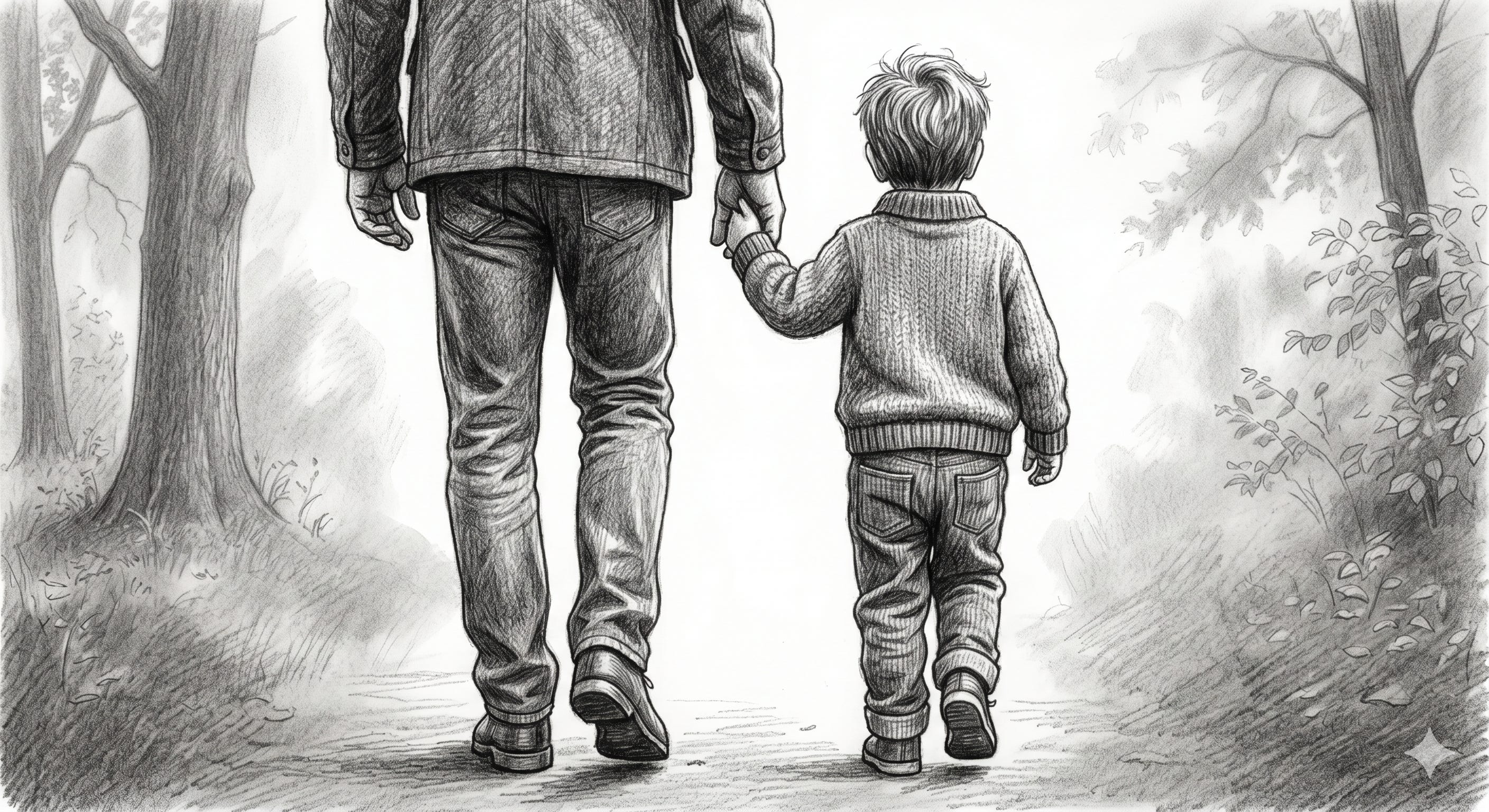
My father was not a villain. If he had been, the grief would be simpler. He was funny and capable, he cranked AC/DC in the car and let me steer from his lap, and he taught me to ride a bike and handle a car in the rain. He was also a meth addict whose rages broke our family apart, and he was absent in the ways that mattered most. Both of those are true and I have never found a way to put them down.
When I became a Christian at fifteen, I was not only finding a religion. I was finding a father who would not leave. I had been told there was one who knew everything about me and stayed anyway. For a boy who had spent three years bouncing between his mother’s house, his father’s house, and a friend’s couch, that was not a hard sell.
What I built around that offer was elaborate. A literalist theology that gave me a perfectly consistent father, a moral structure to replace the chaos at home, and a run of pastors and mentors I went through with a hunger none of them could have satisfied. Then I poured the same hunger into a career. Every structure I built was an answer to the same absence.
It worked, or it felt like it did.
When it failed
In October of 2023 my faith collapsed. What actually came down was the system I had built to manage my father hunger. The theology was load-bearing, and everything sitting on it came down with it.
Two weights arrived at once and it could not hold them. My father died. And I became a father myself.
There was something the system had been carrying that I did not know it was carrying. I had believed that if I lived this faith well enough, it might reach him. That he could change, the way I had changed, and I would finally get to have him. When his heart stopped, that went with him.
What replaced it was a question I could not get out from under. I would rock my daughter to sleep against my chest and feel a love I would have walked into anything to protect, and I could not understand why he had not felt that for me. Then the same question turned toward God, who was supposed to be the better father and had watched the whole thing happen.
I did not want a demolition crew
When I went looking for help with the collapse, most of what I found was people eager to help me tear down whatever was left. I had already watched a life without meaning consume my father. I was not going to hand mine over to it.
What I needed was not another system. It was a way to be a son who could finally name what he never got, and a father trying to give his daughters something he was never given.
What this is
I am not a theologian or an academic. I spent my career analyzing complicated systems, and I have turned that on the one that matters most to me, which is my own.
I am writing for people who built their whole world on something, religious or professional or ideological, and watched it fail. For anyone still carrying a father who was not there. For fathers working without a model.
I am not writing from the other side of this. I am writing from inside it.
The first essay is below…
1. The Birth of the Hyper-Vigilant Protector

Our bodies carry a biological ledger of the environments we survive. In a predictable home, a child’s central nervous system rests at a stable, calm baseline. But when the initial conditions of a childhood are defined by addiction and volatility, the nervous system adapts by running hot. It calibrates itself to a state of constant, hyper-vigilant antici…
This is so deeply relatable in multiple ways.
The way you describe building structure around complex, chaotic systems really resonated with me. I used to describe myself almost exactly that way: “I bring order to chaos.” It’s how I ended up in management consulting and then data analytics. From the outside, it looked like ambition or competence, but underneath it was a hyper-vigilant nervous system trying to manage the environment because, for a long time, not being able to manage the environment felt unbearable. I had to rebuild from the inside out.
In my case, much of it was also connected to my father. And what you named feels especially important: he was not a villain. That is part of what makes the grief so complicated.
My dad believes he was heroic as a father because he was “around,” but he is also a deeply complicated person who carries his own childhood wounds so far in front of him that I don’t think he can see the person across from him.
We stopped talking a few days after I had my daughter, and he has never met her. I carry grief about that, and also grief around the possibility that he may never meet her and that we may never speak again. He is paralyzed and has had serious bouts of illness, so there is a very real awareness that time may not be endless.
I’m really glad you found me here on Substack. It means a lot to meet people who understand these kinds of wounds from the inside, but who are also doing the work to heal, rebuild, and become something more whole than what they were handed.