


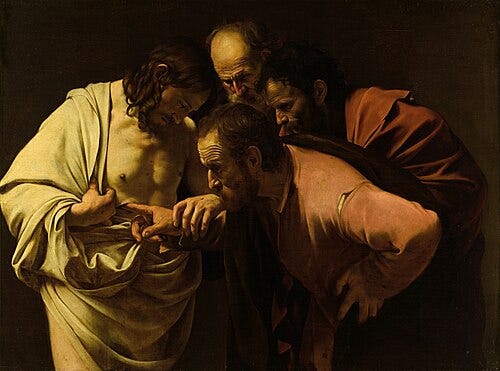
But he said to them, “Unless I see the nail marks in his hands and put my finger where the nails were, and put my hand into his side, I will not believe.”
John 20:25 ESV
I still remember the night my certainty in the resurrection collapsed. It was late and I was running a bath after a long day at work. While I was filling up the tub, I was listening to Alex O'Connor talk to Bart Ehrman about the reliability of the resurrection accounts. They were talking about Paul's vision on the road. Ehrman did not doubt that Paul had it. What he did was lay out how that vision could be explained and still not have been Jesus. The part that was devastating to me was this. Paul's experience was not the same as what the disciples had. Paul did not interact with an embodied Jesus. He saw a blinding light and heard a voice. For most of my Christian faith, Paul's conversion had been the bedrock I built my certainty on. His historical credentials felt more secure to me than anything else in the New Testament.
Bart did not disprove the resurrection in that podcast. But he did take away my ability to be certain of it.
The moment his argument about Paul landed, the floor dropped out from under me and the room felt like it was spinning. I had to sit down because of how disorienting it was. To me, this wasn't just a faith I believed in. It was a fact I held with an intensity that kept me alive. I was afraid that if I ever lost this certainty I wouldn't want to stay on earth any longer.
What let me survive it was learning that my safety had never actually been resting on the certainty. It only felt like it was. Once I could separate those two things, I was able to come back and do an autopsy on the faith I had held for the past twenty years.
I was brought up in a chaotic childhood with two parents who were meth addicts and who were not religious in any way. When I was twelve, I got set on fire after I smoked pot for the first time and denounced God's existence. I won't go into that night here, but it shaped everything that came after. What it left me with was a God who was deeply dangerous, who would destroy me if I disrespected him, and who had the means to do it in the most horrible ways possible.
So a year later, when I was thirteen and planning to go do things I felt were wrong for me to do, I asked my mother what she thought about the Bible. I still remember riding in that old grey Oldsmobile, and the justification I received as she drove me.
"I think it's made up, like the story of Santa Claus, to make us behave well."
Hearing that come from my mother was deeply comforting and stuck with me. That was all I needed to feel good about the choices I was about to make.
At fourteen our house was raided for drugs. I was held at gunpoint, handcuffed, and left in a cop car outside the house for over two hours. By fifteen I was smoking pot again, and one night I smoked some that was laced and had a panic attack and thought I was dying. A girl who liked me had told me over and over that I needed to ask Jesus to save me from my sins, and I had never understood what she meant. But on that couch I reached for anything I could before I thought I would face God, terrified I was going to end up in Hell. I prayed to Jesus to save me.
I woke up the next day on that couch. I felt a deep sense of relief and swore off drugs. I still wouldn't have called myself a Christian. I didn't know what that meant and I didn't tell anyone what happened.
That same girl who told me about Jesus found out I was moving and invited me to a summer church camp. I didn't care about the camp. I wanted to see my friends one last time before I left for good.
I went with no plans of telling anyone about the prayer I had prayed while high, or of getting close to God in any way. What I didn't know was that my body would listen to the story in a way I never had before. When the youth pastor talked about Jesus and my need to ask him to save me, I didn't understand the theology. I was a hurting boy who hadn't lived with either parent full time in almost two years, who had been using drugs, who had been through the public humiliation of a drug bust in a small town, and who had been suicidal.
What that youth pastor was offering was not just eternal salvation. He was offering me something I deeply yearned for, that God actually cared about me in a way my family never had. Most of what he said I didn't understand. What I did understand was peace with God, forever. So when he asked everyone to close their eyes and bow their heads and raise a hand if they wanted it, my hand shot up right away without hesitation. My body wanted this more than any objection or skepticism could stop.
And that week gave me the embodied safety I had been yearning for. All the adults were safe. The kids at the camp didn't mock or use insults, but encouraged one another and genuinely sought to care for me. I came home with what felt like evidence that this faith was the solution to my family's brokenness, and that if they experienced it, they would all change and we would be a family again.
This faith was the first hope I had ever been handed. I had no reason to believe my life would get better on its own, and I had already attempted suicide once. I don't think it's dramatic to say the odds were good I would have tried again.
I didn't become a committed Christian at that camp. It wasn't until about a year later, when a close friend died in a motorcycle wreck, that I was confronted with death in a way that made me ask whether this faith was something I actually believed and whether it actually had power. Around then I got my hands on a teen study Bible and began in the New Testament, and for the first time I read the words of Jesus.
I remember being enthralled with him. I couldn't believe how life changing his ideas truly were. I had never heard anyone talk about loving my enemies or living in a self sacrificial way. My parents never discussed these ideas with me.
I had the thought, this was who I asked to save me?
Once I discovered his teachings, it was like I unearthed treasures that I had inherited. But they were too valuable to risk losing, and I needed to know they were irrevocable, so I demanded to audit the will and make sure that these were actually mine to have. And the only way that could be true was if I could verify that this Jesus was real and his story wasn't fabricated.
As a child who had lived most of my life in deprivation of safety, I developed distrust and hypervigilance as my greatest tools to protect myself. Not because I wanted to, but because my survival depended on it. I had moved in with my grandmother by then, and for the first time I wasn't worried about whether I would have food, whether violence would randomly break out, or if the police were going to burst in at any moment. That was the space I needed to actually look at this. I started pressing my history teacher at school on whether the gospels were historically reliable. He was also the youth pastor who had led me in that prayer at camp.
I read these stories alone in my grandmother's house. There was a moment where I hugged the Bible as I read it because of how deeply I longed for Jesus's physical presence. Jesus to me wasn't just someone dying to save me from Hell. That was who he was at first, for sure, but once I had read the stories of who he was, he represented the perfect image of what a man should be. I saw him as the ideal father figure, leading me to live in a way that was counter to everything I had experienced.
So once I had enough to say I was certain of Jesus's life on earth, I allowed myself to feel like I could have certainty of his resurrection.
The faith wasn't optional for me. It was lifesaving. It let me reinterpret my life, gave me hope for my family, and gave me a future to look forward to.
Then I entered college and was exposed to worldviews that threatened my safety. In order for my faith to survive them, I doubled down on the inerrancy of scripture. I needed it to be literally true to keep me alive and these professors didn't know the weight the faith was protecting me from.
How could they?
So I built the wall of certainty. The more certain I was in my interpretation of the Bible, the more certain I was in the story of Jesus, and the safer I felt. By the end of college I had decided to pursue a PhD in theology instead of nutrition.
Two things began to break the wall down, and neither one was me trying to leave the faith.
The first was that I became a father.
There was a rhythm I had built with my first daughter at the end of the day. I read her a book, then turned off the light and held her against my chest and rocked her until her eyes began to close. One night I was in the chair with her nearly asleep, and I looked at her face in the dark, and the love that came up in me was bigger than anything I had felt before. There was no threat to her I would not have walked straight into to protect her.
I loved this child this much, and she was helpless, and every part of me rose up to keep her from harm. I had been that helpless once too. The God I had built my whole life on was supposed to love me with that same love and more, and he had watched the childhood I came from and let those things happen to me, when he had every power to stop them.
The pain of that idea was too great, and my anger moved in to suppress the grief. I couldn't grieve it, and talking about it with other Christians didn't help. Every answer they offered came back around to sin, mine or my father's, and left me with a small child who somehow had it coming.
The second was that my father died.
The day it happened I was replacing the interior doors in our house when my brother called to tell me Dad had a heart attack and they were taking him to the hospital. They had already brought him back twice. I sat down in a chair in our bedroom to calm myself, and then I went back to the doors. I cried, a little. Not sobbing, not from anywhere deep, just a tear or two every so often while I kept working.
That night, after we got our daughter down, Mary and I put on a movie, and nothing I picked was landing for her, and I came at her hard over it. "Just let me pick. My dad just died." She said, "I'm sorry. You seemed like it wasn't even affecting you. I didn't know."
The hope I had been carrying since I became a Christian at fifteen died with him. That he would adopt the faith and he would be the present father I knew he could be.
Anger was the only emotion I could reliably reach when grief came up. I didn't cry at his funeral. Sitting in my childhood grief was not safe and there never had been room for me to do it.
My wife encouraged me to get counseling. What I didn't expect was how it would open my access to my childhood, and how much grief I had suppressed, and how the faith had been one of the ways I suppressed it. It was only through therapy that I started to see how completely I had fused my body's need for safety with my certainty that the story was literally true.
After those two events, and the work of therapy, my body stopped letting the testimonies I had always accepted satisfy my need for certainty. Nothing about the evidence had changed. I had just experienced something real enough that the faith now had to meet a higher standard to keep regulating me the way it had.
I believed that if I lost the certainty of the resurrection, I lost the foundation of my safety.
But what I'm now able to articulate is that I never actually possessed certainty in the resurrection in a verifiable way. I had certainty in the testimony of individuals who asserted that the resurrection had happened, and in my own ability to construct a bulletproof chain of reasoning.
But that chain of reasoning was never what settled my body. Defending it was how I guarded the thing that did.
I had been using the same word for two different things and never noticed. There was the certainty I felt, which was the thing in my body telling me I was safe. And there was the certainty I could actually claim, which depended on whether I could verify anything. In my life those two always showed up at the same time, so I never had a reason to separate them. But the one that was keeping me alive was the first one. The one I spent twenty years defending was the second.
At fifteen, that week at church camp, I didn't possess certainty in the literal claims of the faith. Faith had provided me with a regulated and embodied experience that was doing work in convincing me of its power and usefulness. I couldn't have made any sound theological arguments or have proven that Jesus was even a real person on earth.
But once the faith came under attack from those outside of it, the intensity of my childhood suffering and the lack of parental care meant I needed to defend the literal claims to keep the story. I was worried if it wasn't literally true, it would stop regulating me the way it had at that camp.
The thing I'm trying to make sense of is this: what can we have certainty in, and what can we reasonably require from another person?
I think for most Evangelical Christians the most basic test of whether someone is a Christian is how they answer this: do you believe that Jesus physically rose from the dead?
I required it of other people myself. I witnessed to strangers, to friends, to my own family, and every time I was asking them to be certain of something I now know I was never certain of either. I was not lying to them. I believed I had it. But I was handing people a test I could not pass, and I did not find that out until the certainty was gone.
Can any Evangelical Christian actually claim they are certain of the literal resurrection of Jesus? Certain in the way they claim I have to be certain in order to call myself a Christian, and in the way they require other people to assent to it in order to be saved by Jesus?
Here is the difference between us and the disciples. The disciples saw a resurrected Jesus they could touch and eat with. It was an embodied figure that was undeniable. Jesus in the gospel of John doesn't seem to have a problem with this type of proof being required. The book is built around seven specific embodied stories, miracles that point to the reality that he was actually the messiah.
The gospel of John saves the story of Thomas for last, the most embodied proof given of Jesus's resurrection in all of the New Testament. Jesus doesn't rebuke Thomas for needing the proof. He even offers Thomas the ability to put his hands into his wounds. He does bless everyone after Thomas for believing without seeing him.
But Jesus was willing to offer his wounds to convince him.
If I say, like Thomas, that I cannot be certain of the resurrection unless I can put my hand in his side, what does that make me?
Would Jesus, if he actually rose from the dead, condemn the person who honestly wants that kind of proof? Why did Jesus give Thomas the ability to do that, if he was opposed to us demanding an embodied proof?
I think many people are holding onto that question, and if it was answered the way it was for Thomas, they would be able to speak about Jesus's resurrection with certainty.
But as it stands right now, no Christian, at least that I've met, has been able to put their hands into the wounds of Jesus. So the certainty they have is not in the resurrection, but in the testimony of someone who did touch him.
Almost everyone I love is still inside the faith.
My oldest daughter knows I am no longer sure about Jesus. Ever since I told her, she has been afraid of what happens to me when I die. She writes me cards with Bible verses in them, hoping they will help me believe. I keep every one of them. I do not have an answer for her that doesn't cost one of us something.
My wife and daughters go to church each Sunday without me. At bedtime my wife prays with the girls, and they ask me why I don't pray with them.
My closest friends believe I am wrong about the most important thing there is, and nearly all of them are kind about it, which is somehow harder than if they were not.
There is a part of me they cannot reach now, and a part of them I cannot reach either. None of that is because anyone stopped loving anyone. It is because I cannot produce the one thing that would close the distance.
I can now sit with the beauty of the story of Jesus and the incarnation and long for it to be true. I love the fact that people got to physically interact with Jesus. Honestly, this is still why I can't leave Christianity alone.
It matches a deep need to be loved and seen by a parental figure, especially for someone who, as a child, didn’t have a father who could do it. I desire to interact with God in that embodied manner that those people experienced.
But I don't get that. I tasted a small embodied version of it in individuals in the church. I still feel it in the power of the narrative. But what I yearn for is to experience that true embodied presence of God. I am asking for a proof that Jesus himself didn't condemn, proof that can be checked by an embodied physical experience.
What I will not do again is ask certainty to do a job it was never built for.
I stand with Thomas before his experience and say I can't believe it unless I can put my hands in his wounds. Not because I don't want it, but precisely because I deeply do want it.
Was Thomas a Christian only after he got his proof and made his confession? He spent a week where he had heard the testimony of people he trusted with his life and still could not say he was certain.
And if he was a Christian during that week, then how many of us would say "my Lord and my God" if we were handed a physical Jesus to put our hands on?