

One of my first memories of my mother is her celebrating my birthday. I remember her asking me what cake I wanted, and getting me a root beer float to start the day off before the celebration. I would have been younger than five. I remember her surprising me with a Jurassic Park poster after we saw the movie in theaters when it first came out. That poster taught me how to spell Jurassic Park at six, and I would spell it for anyone who would listen. I remember the special valentine presents around that same time. Any child likes a toy. But for me it meant my mom was thinking about what would make us happy.
Soon after Jurassic Park, my mother’s focus shifted. It moved from what would make us happy to us sharing in the emotional struggles of her life.
She has always been present in my life.
But being present in a child’s life is not the same as embodying a good mother.
Shortly after Jurassic Park came out, my family life became chaotic. My father’s outbursts and aggression became a fixed reality. Then one day my mom wasn’t living in our house. I didn’t know why. I’m sure a reason was given to me, but I didn’t understand it. I remember feeling despondent and confused. My dad was deeply depressed about her absence. He would sob in his bed with us three small kids sleeping next to him, there to give him a small amount of comfort while she was gone.
Then one day my mother showed up at the house. I remember how excited I was to see her, how badly I wanted to hug her and talk to her. I was frantic to get to her. My dad told me to stay in my room while he talked with her. This was the first time my father physically abused me. I kept trying to push past him, and in his anger at me for not listening, he grabbed me by my throat and threw me back into my room and shut the door. I don’t have much more from that memory. I don’t know if I got to see my mom that day. I don’t know if my father apologized, or if I just sat in my room and cried. All I can remember is his anger and getting thrown.
My father was the obvious one. His anger was immediate, physical, and impossible to miss. There was never a question about the damage he did, and it was easy to point at him as the villain. That was especially true for me as a child. Things are black and white at that age. My father is physically harming me for the crime of missing my mother. He’s the bad guy. My mother didn’t know what was happening.
The reason my mother was gone was that she and my father had been using meth together. The batch was strong enough to cause a psychiatric break. She was hospitalized, and then admitted in-patient to a mental hospital.
My mother had known my father was a meth addict from the start. Their relationship was unhealthy from the beginning. She told me he asked her to marry him one day on the couch. He did not propose or make anything of it. He asked her the way you ask someone what they want for takeout. But that is the thing. When you grow up with a childhood like my mother’s, you settle for what you should never settle for, because you have been conditioned to believe you are not worth the pursuit.
She stayed because she believed it was the best she could do. She overlooked his drug use because she was doing the same things. By the time I was old enough to know my father was using, my mother had mostly stopped, and she had begun blaming everything wrong in our lives on him.
Because my father was the greatest physical threat in my childhood, I couldn’t see my mother as part of the problem. There were times I was so afraid he would kill her, or the three of us, that his mood decided whether our bodies got to be at peace. I had no idea what parentification meant. I never saw my mother as someone harming me. I saw her as a helpless victim of my father’s wrath, and as someone who needed protection.
My mother’s upbringing was traumatic. Her relationship with her own mother was horrific. Her mother said things to her that no mother should say to a child, and I understand why my mother struggles to be the mother I needed. At every corner there is a good reason for why my mom was the person she was. There is an abusive story to explain her behavior, her lack of hope, and her need for me to comfort her.
But I didn’t understand until I became a parent myself that there are things no parent should ask a child to bear in order to make their own suffering better. I couldn’t hold that weight as a child. I still can’t carry it now.
That was the shape my relationship with my mother took. I became her protector. In my book, the night I write about the birth of my hyper-vigilant protector, he is not only the protector of me. He is the protector of my family, and of my mother in particular. I saw the fear in her eyes and heard it in her voice. I felt her tears and her pleading with my father during those fights. I began to carry my mother’s pain in my own body. When I interjected, it was to protect her.
As I got older I learned more about my father. Things a child that age should never know. I watched my mother get drunk and tell me how she and my father had cheated on each other, more than once. I was eight. I cried and hid in the laundry room, and my brother and the rest of the family laughed at how upset I was. I was ashamed. My idyllic picture of my parents was breaking in real time, and I couldn’t tell my mother how much it hurt, because she was drunk. I couldn’t mourn it.
That little boy learned that his pain and his disappointment were not welcome in the world he lived in.
After their fights, my mother’s account of my father was always the same. He was terrible, he treated her badly, he was dangerous. I remember the night he held her at gunpoint. She described to me, nine years old, how sure she was that he was going to kill her, and how we needed to get away from him. We stayed with a friend of hers for a few days.
Then they made up, and we were back in the house.
As a small child, making sense of that is close to impossible. One moment your father is a monster. The next, your mom is holding his hand and the world is good again. This continued through my childhood and into my college years. They fought, split up, and got back together more times than I can count. I don’t know the number.
As a parent, my job is to stand between my children and the dangers they are too young to carry. My mother’s life was legitimately terrible. It was still her job to protect me, and she failed me. I needed a mother who shielded me from her own pain and gave me a fresh start. It was never my job to right the wrongs she went through. I couldn’t make my father not be abusive. I couldn’t make the world right for my mother.
Here is what most people don’t understand about a terrible childhood. It doesn’t stay a childhood. It follows you.
After Mary and I had our first child, my mother came to visit. She stayed the night and cried about how lonely she was, and about living at her mother’s house. I told Mary I wanted to build onto our house and move my mother in with us. Mary was willing.
Mary’s mother talked me out of it. She said it was a noble thing to want, and that I should help my mother get a place of her own instead. Her own parents had lived with her for the last decade of their lives, and she told me it would change the entire dynamic of our marriage.
So I moved my mother to our town and helped her get an apartment. I furnished it. I gave her my car. I brought her to church and tried to introduce her to people, hoping she would find some community. By then she had been on disability for her back and out of work for over a decade, and ordinary conversation had become difficult for her. The interactions were awkward for her and for nearly everyone I introduced her to. This was 2017.
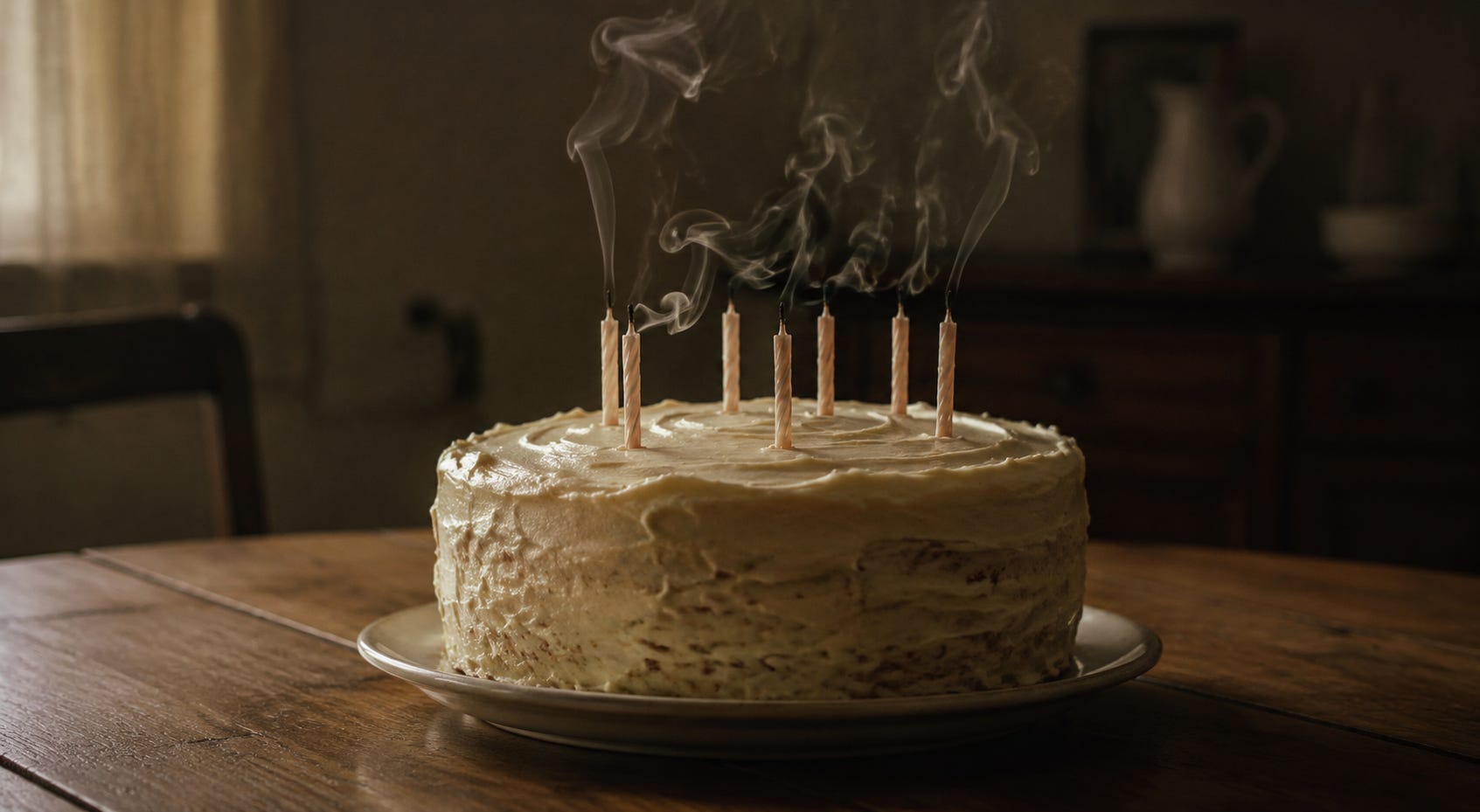
Mary made her a birthday cake. We brought her over to celebrate. I don’t entirely remember what set my mom off that evening, but she was sullen from the start of it. I remember the shock on Mary’s face, and how she got up and left the table. I raised my voice at my mother about how she was treating Mary, and how hard Mary had worked to make the day special.
Then my mother started crying, and I asked her to leave.
My father died in April of 2018. My mother did not comfort me. The reverse happened. She came to church with us not long after, and during a song she started crying. I assumed it was about him. She grabbed my arm. I have never wanted to shove someone as badly as I did in that moment. This was before I understood what my anger was doing, how it was standing in front of something deeper that wasn’t being attended to.
I didn’t know I needed a mother to comfort me about my father’s death until after he died.
More than that, I didn’t know I had never truly had a mother until after he died.
With him gone, I could finally see the rest of it. How she failed to protect us. How she kept taking us back. How she asked us to hold the pain of her childhood and to give her a sense of purpose.
How my childhood was stolen from me because hers had been stolen from her.
Two weeks ago she texted me at 11:45 at night. She was about to be homeless and she was scared.
I was enraged.
I texted her back the next morning. I told her she had refused my help three months ago, the help that would have kept this from happening, and that I can’t do this any longer.
My rage is guarding a grief I have carried since I was six.
There was no funeral for it. No one brought food. No one offered condolences. Nothing happened that would let a child understand what he had lost. To everyone else, my mother is still alive. To that six year old boy, the mother who once held him and celebrated his life died when the chaos started, when she disappeared from our home and was admitted to a psychiatric hospital.
A relationship with my mother drains the life out of me. She has not been able to give me hope or encouragement in any meaningful way since that year. I want to sob about the loss of her. I can’t, because she is still alive, still needing me to parent her, and the child in me still feels responsible for her.
I hate that I long for the day she is no longer on this earth, because then what I live with will finally match the death I experienced over thirty years ago.
I still need a mother. Saying that makes me vulnerable. Not because it is bad to want a mother, but because mine will never be able to be one.
Happy birthday, mom. I wish our relationship was different.