


In neonatal medicine, “Kangaroo Care” refers to the practice of placing a premature infant skin-to-skin against a parent’s chest. Medical science discovered that a newborn’s central nervous system cannot self-regulate on its own. Without that physical touch, a baby’s cortisol levels spike to toxic thresholds, its heart rate destabilizes, and it can literally waste away and die. The skin-to-skin contact sends an unspoken biological message to the infant’s nervous system: “You are safe.”
I remember when I first learned this last year, I began weeping. It was such a profound truth that I understood it at my core. I couldn’t help but weep for the reality of it, and for the depth of sadness I felt for the children who historically died as a result of “Failure to Thrive” (marasmus), which is, at its root, a total lack of central nervous system regulation that is biologically necessary for survival.
But what happens when that foundational “holding” is completely absent as a child enters their preschool years?
The central nervous system perceives the universe as a permanent, existential threat, forcing the child’s ego to develop in a maladaptive way. It doesn’t develop as a healthy vehicle for exploring the world. Instead, it develops as a rigid, hyper-vigilant survival suit designed to keep the child from psychological and physical death.
In public health, this kind of environmental trauma is measured using the Adverse Childhood Experiences (ACE) score, a 10-point scale tracking categories of exposure to abuse, neglect, and household dysfunction.
I am a 10 out of 10.
To understand the dynamics that lead to a human being achieving a 10 rating on the ACE scale, you have to look at the broken code running inside the people who created me.
My Father’s Debt
My father grew up as the fourth of five children, born to parents who were themselves the product of a shotgun wedding. His sense of worth was forged in a profound deficit. He grew up starving to feel loved, seen, and appreciated by his own father. By the time he was 15 years old, he was completely desperate for the validation he never received at home.
When a primary, father-to-son bond breaks, a vulnerable human being will pursue a horizontal relationships to survive. My father sought out a peer group of older friends he looked up to, desperate to feel cared for by an older male presence. To feel their love and affiliation, he did things a normally healthy child wouldn’t do. He allowed a friend to shoot him up intravenously with methamphetamine at 15, something that would have ripple effects throughout his entire adult life and our family’s life.
The drug was not just a chemical vice. It was a counterfeit, maladaptive substitute for the biological warmth and validation that he had been starved of, and it would hinder his ability to pursue healthy relationships for the rest of his life.
My Mother’s Debt
My mother’s trauma cut directly into the metaphysical core of existence. She grew up with a profound lack of connection with her own mother. She has shared with me foundational memories of her mother saying to her in anger, “I wish you were never born.”
If Kangaroo Care is the ultimate affirmation of Being, then my grandmother’s words were akin to a psychological execution. It was the absolute withdrawal of all safety. To survive a maternal presence that actively wishes you out of existence, my mother had to also look horizontally to find consolation, causing her emotional development to become deeply maladaptive.
When an internal world is that depleted, a permanent state of emergency sets in. Her subsequent emotional immaturity and co-dependent relationship with my father inevitably led to her also abusing drugs and staying with him way longer than she should have.
The Intergenerational Landslide
These two deeply wounded, egos naturally bled into their parenting and shaped the chaotic childhood environment I inherited.
My father was trapped in severe, destructive, terrifying rage fits during his comedowns from meth-induced highs. My mother, entirely unable to regulate her own internal states, projected her emotional needs directly onto her children. As a young boy, internalizing a parent’s unstable psychological weight and being in the middle of their emotional warzone was a crushing, impossible burden.
My nervous system could not tolerate the dysregulation. To survive, at just 12 years old, I began staying overnight regularly for extended periods of time, bouncing between friends’ houses and self-medicating with drinking and partying. I was already seeking to artificially quiet my own hyper-vigilance.
The Warden Had Enough
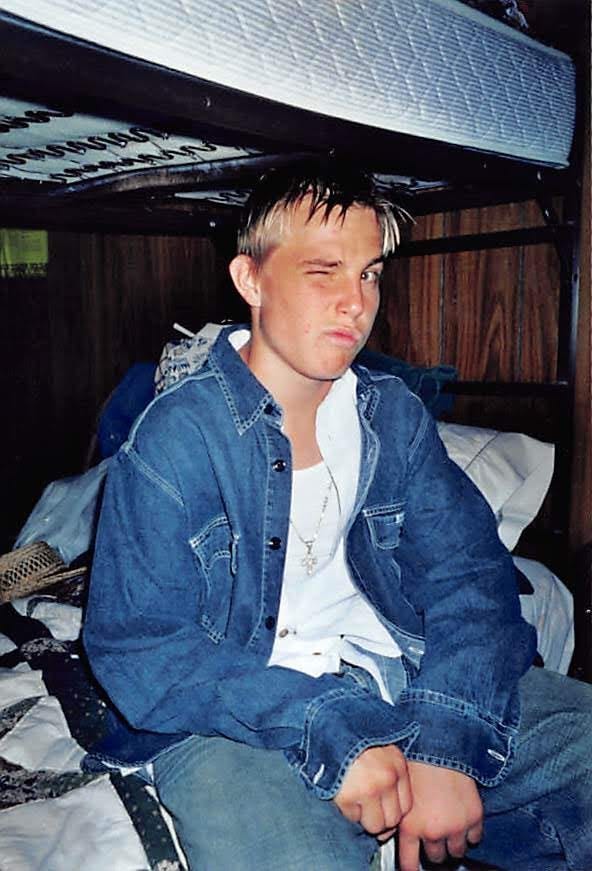
From 12 to 15, I stopped smoking pot for fear God would finish the job. However, I continued drinking and partying, because in my mind, the line was pot. It wasn’t until the day of my 15th birthday that I would smoke pot again.
I was in the living room with my cousin, siblings, and my parents at my dad’s house. They were all smoking pot and were encouraging me to do it as well. I felt very reluctant because of the fear that God would kill me. I even shared what had happened to me, and most of my family laughed about it, saying it was just a coincidence and that wasn’t God. So I caved into the peer pressure to feel connected to them. I felt so conflicted, I wanted their approval and connection, and simultaneously I was terrified about what would happen with God. I caved and smoked with them, all the while terrified.
The next day, I stayed home from school and just stayed in my bed all day. I thought if I didn’t leave the house, nothing bad could happen to me and I’d be safe from God. I know all of this sounds crazy, but I literally thought God would harm me if I left the house. After the next day had passed and no harm had come to me, I thought, “Maybe my family was right. Maybe it was a coincidence.” Thus began a phase of frequent pot smoking. I’d smoke on the weekends and even leave school during our lunch break to get high with my friends and finish the school day high. Pot really numbed me and allowed me to decompress the hyper-vigilance. However, this honeymoon period of pot smoking and relief would not last.
One night that summer, I was sitting on the couch, high on pot that, unbeknownst to me, had been laced with an unknown hallucinogen that my cousin had gotten from my father’s own stash. I literally felt like I was going to die and began panicking. God had come to finish what he warned me of as a child at the lake.
Little did I know I was having a panic attack, an experience that would become a significant driver of my relationship with God over the next few years. In that moment of absolute terror, I began bargaining with God not to kill me, and if he did, to at least forgive me so that I didn’t end up in hell.
I didn’t die. I woke up the next day, buried the terror, and told no one.
A Bright Light Dawns
It wasn’t long before that event caught up to me and I entered into a severe depression. I was living with a friend at the time, and my mom had moved to another city. I called my mom crying and asked her to come pick me up. I told her that I was worried about what was happening to me, that I might have damaged my brain with the drug use, and that I couldn’t feel happiness. My central nervous system regulation had begun to fully fracture and I couldn’t see a way forward. After I moved away, a friend from my old school invited me to church camp so I could see everyone one last time before the summer ended and I started at my new school. For the first time in my life, even though I’d heard this offer many times before, I was truly primed to pay attention to the offer of Christianity.
On the first night of the camp’s week-long stay, I heard the evangelical message of Jesus and the need to confess my sins and how God would forgive me, have a relationship with me, and I’d live with him forever in heaven. My brain connected the dots immediately and it was like a light bulb lit up. The “sin” was my family’s chaos, the drugs, the fighting, and all variations of evil. The “salvation” was not dying on that couch that night and safety from the ongoing perceived threat of God’s destruction. Christianity was offering me forgiveness, connection, and a safe place. Everything my central nervous system was screaming for.
Under the guidance of the youth pastor, I repeated the prayer he led me in so that God would forgive me, and I accepted Jesus as my savior. I felt an immediate peace for the first time in a very long time.
Looking back, I realize I had locked onto the faith as a form of metaphysical Kangaroo Care.
And honestly, it was amazing at camp the rest of the week. I felt close to the people around me. No one was screaming at each other, acting hateful, doing drugs, or being threatening in any way. Everything about this camp and this faith felt better, the exact opposite of what my childhood had been these last 6 years. It was like a veil had been removed from my eyes, and I saw for the first time the brokenness of my family’s way of living and the beauty of what life could be if I chose to follow the commandments of God.
Upon leaving camp, I couldn’t wait to get home to tell my mom about Jesus. I felt as though I possessed knowledge that my family didn’t have, and once they heard about my experience and what Christianity was offering, there would be no way they’d deny it or not want to be a Christian.
Unfortunately, I was sadly mistaken.
Continue the story below..
4. The Butterfly Effect

In chaos theory, “The Butterfly Effect” describes how tiny, microscopic changes in the initial conditions of a complex system can cascade into completely unpredictable and catastrophic outcomes. The classic example is a butterfly flapping its wings in Brazil and setting off a tornado weeks later in Texas.